How to Write a Real Estate Press Release: Start With the News, Not the Property
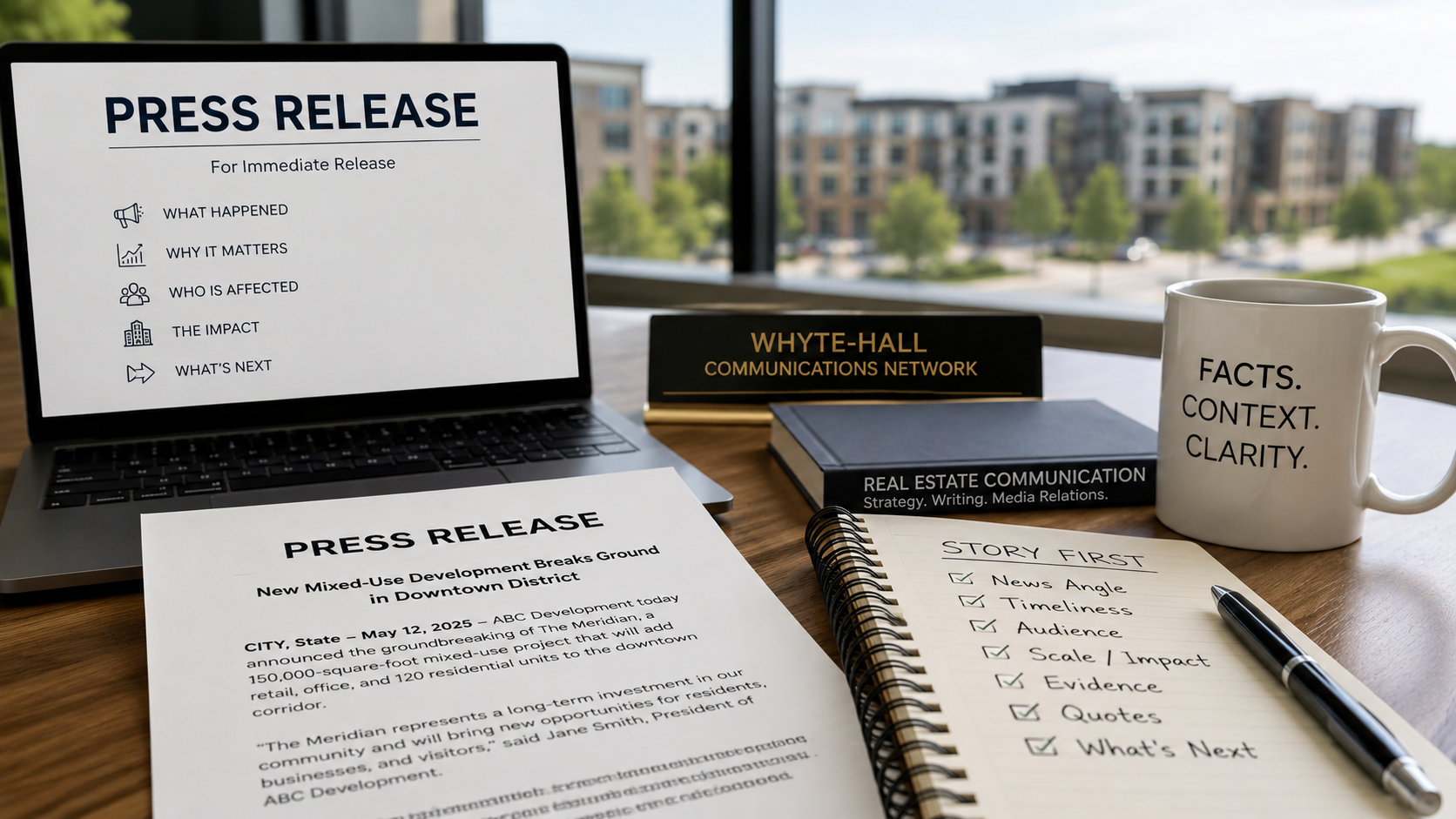
A real estate press release can be perfectly competent at the sentence level and still fail as a piece of public relations writing. The problem often begins before the first sentence is drafted, when someone decides that an event deserves a press release without first asking whether there is a genuine story behind it.
That distinction matters because a press release is not simply another format for promoting a listing, announcing a closing, or describing a company milestone. It is a document prepared for people who make editorial decisions. Journalists and editors need a reason to believe that what happened matters beyond the organization making the announcement. If that reason is weak or missing, polished writing will not solve the problem.
The first job, therefore, is not writing. It is reporting.
The Property Is Not Automatically the Story
Real estate professionals naturally know a great deal about properties. They know the square footage, bedrooms, amenities, finishes, acreage, asking price, location, and neighborhood. In commercial real estate, the list may extend to occupancy, tenant mix, development costs, financing, capitalization rates, and investment terms.
Those facts may be important, but they do not automatically create a news story. A new listing, for example, may matter greatly to the seller, the listing agent, and prospective buyers without giving a journalist any particular reason to cover it.
The situation changes when the property carries something larger. Perhaps it is being offered publicly for the first time in 80 years. Perhaps it is a historically significant building being adapted for a new use. Perhaps the transaction affects a neighborhood, introduces a major redevelopment, or changes the use of a prominent site.
The property has not stopped being the subject. What has changed is the story around it. That is what the press release needs to find.
Start With What Happened
Before writing a headline, reduce the event to one clear sentence.
What happened that did not exist, was not known, or had not occurred before now?
A brokerage opened its third office. A developer received approval for 420 housing units. A commercial property sold for $42 million. A real estate organization released new research. An agent completed an unusual transaction. A company entered a new market.
That gives you the event, but not necessarily the story.
The next question is more important: why would someone outside the organization need to know?
That is where PR writing begins to separate itself from promotion. The event tells us what occurred. The larger story tells us why it may deserve attention.
Establish Why It Matters
Suppose a brokerage announces that it has opened another office. “ABC Realty Opens New Office” tells us what happened, but it does not tell us why anyone outside ABC Realty should care.
Now suppose we learn that the brokerage has grown from 12 agents to 48 in three years, that its transactions in the new market increased from 27 to 146 during the same period, and that the expansion will add six local employees.
The office opening now has context. It is no longer only about a new address. It reflects measurable growth, geographic expansion, and potentially a change in the local market.
The office opening is the news peg. The growth behind it is the larger story.
That distinction is important because many weak releases stop at the event itself. Stronger releases explain what the event demonstrates, changes, or makes possible.
Use Numbers to Establish Scale
Words such as major, rapid, significant, and substantial are easy to write because they ask the reader to accept the organization’s judgment. Numbers are more useful because they allow the reader to make that judgment independently.
Instead of saying that a brokerage has experienced rapid growth, show the movement: it grew from 12 agents in 2023 to 48 in 2026.
Instead of saying that a development will provide much-needed housing, establish what can actually be measured: the approved project calls for 420 apartments, including 84 income-restricted units.
Instead of saying that a company has expanded significantly, show the scale of that change: annual revenue increased from just over $1 million to more than $4 million over five years.
The point is not to fill a release with numbers. It is to use numbers where they help the reader understand magnitude, change, or consequence.
Put the Strongest Facts Early
A press release should not make the journalist search for the news. The opening should establish the central event and enough context to explain why it matters.
A weak opening may spend valuable space describing the company as innovative, client-centered, award-winning, or committed to excellence before reaching the actual announcement.
A stronger opening goes directly to the development:
“ABC Development received final approval Tuesday for a 420-unit housing project in Frederick County, clearing the company to begin construction this fall.”
That sentence gives the reader an event, a location, a status change, and a time reference. Company background can come later.
The early paragraphs should continue answering the questions created by the lead. How large is this? Why did it happen? Who is affected? What changes now? What evidence supports the claim? What happens next?
The release should move through those questions naturally, not through a sequence of company talking points.
Separate Evidence From Claims
A press release is issued by an interested party, and journalists know that. That is why evidence and attribution matter so much.
- If a release says a company is the fastest-growing brokerage in a region, the obvious questions are: according to whom, measured by what, and over what period?
- If it says housing demand is increasing, what data establish that?
- If it says 80% of consumers behave a certain way, where did that figure come from?
Phrases such as “research shows” or “studies indicate” are not enough when the research carries the argument. The source should be identified, and the claim should accurately reflect what was measured.
The language should never be stronger than the evidence.
Do Not Confuse Forecasts With Results
Real estate announcements often involve things that have not happened yet. A development may be expected to create jobs. A project may be scheduled for completion in 2028. A company may expect revenue to reach a certain level. A proposed community may eventually contain 500 homes.
Those statements can belong in a release, but they should be described according to their actual status.
There is a meaningful difference between saying, “The project created 300 jobs,” and saying, “The developer estimates the project will create 300 construction jobs.”
There is also a difference between a proposed project, an approved project, a financed project, and a completed project.
Good PR writing does not erase those distinctions in order to make an announcement sound more impressive. It preserves them.
Quotes Should Explain Something
Executive quotations are often one of the weakest parts of a press release because they are used to express enthusiasm rather than provide information.
“We are incredibly excited and proud to announce this important milestone” may be sincere, but it does not tell the reader anything the surrounding paragraphs have not already implied.
A better quotation explains why a decision was made, what changed, what the organization observed, or what happens next.
For example:
“We began looking at Frederick County after our transactions there more than tripled in three years. The new office puts our agents closer to a market that has already become a significant part of our business.”
That quote has a reason to exist. It explains the decision.
A useful test is simple: remove the quotation marks. If no information is lost, the quote may not be doing enough work.
Keep the Main Story in Focus
Organizations often try to make one release carry too much. An office expansion becomes an opportunity to mention an award. Then an executive’s upcoming book. Then a company anniversary. Then a new service.
Before long, the reader is following several announcements instead of one clear story.
That weakens the release.
Secondary information belongs only if it strengthens the central news. If it competes with the main story, it may deserve another communication vehicle.
Focus is not merely a writing preference. It is part of news judgment.
Ask Who Is Affected
Real estate decisions rarely stop at the property line. A development may affect residents, tenants, neighboring businesses, workers, commuters, taxpayers, or local government. A brokerage expansion may affect employees, agents, and clients. A commercial transaction may matter because of what the buyer intends to do with the site.
This is one reason audience scale matters.
The stronger the connection between the event and people outside the organization, the easier it becomes to explain why the story may deserve public attention.
The task is not to exaggerate impact. It is to identify real impact when it exists.
Think About the Journalist’s Next Question
Before the release is finished, read it as someone who does not work for the organization.
What would you ask next?
How much did it cost? Why this location? How many people are affected? When does construction begin? Is financing complete? Who bought the property? What was the previous sale price? How was this percentage calculated? What happens next?
Not every answer belongs in the release itself. Some may belong in a fact sheet, backgrounder, media kit, or direct response to a reporter.
But the PR team should know where the answer comes from, or know that the answer has not yet been established.
That is part of being ready for media attention.
Give Journalists Material They Can Use
The release may be only one part of the assignment. Depending on the story, journalists may also need a fact sheet, map, backgrounder, original research, photographs, captions, renderings, timelines, or source documents.
The question is not how impressive the media package looks.
The question is what will make reporting easier.
If the story involves a new development, a map may be more useful than another executive headshot. If the story relies on research, the methodology may matter more than the company biography. If the story involves a property, a properly identified documentary photograph may be more useful than a staged promotional image.
Supporting material should reduce uncertainty, not add clutter.
Not Every Announcement Needs One
A press release is only one possible communication instrument.
A routine new listing may need a listing description and marketing campaign. A closing may deserve a client communication or social post. An internal promotion may require employee communication. A brokerage move may need direct notice to clients and business partners.
A timely expert observation may be better handled through a direct journalist pitch. A scheduled event may call for a media advisory. A developing story may create a newsjacking opportunity. Some situations need more research before any media outreach occurs.
The governing question remains the same:
Why would someone outside the organization need to know?
If there is no convincing answer, changing the headline will not solve the underlying problem.
The Writing Starts After the News Judgment
Press release writing certainly involves language. The headline matters. The lead matters. Structure matters. Quotations matter.
But none of those things can rescue an announcement that has never been examined for news value.
The stronger process begins with reporting.
What happened? Why now? What makes this different? How large is it? Who is affected? What can be proved? Is the obvious event really the story, or is the stronger story sitting behind it?
Only after those questions are answered should the writing begin.
Because the most common press-release mistake may happen before the first sentence is written:
The organization starts writing before it has found the news.
Continue With the Communication Library
The Whyte-Hall Communications Network Communication Library includes practical resources for evaluating and preparing real estate communication, including the Press Release News Test and the Real Estate Press Release Writing Guide.
The resources can be opened, saved, or printed. No registration or email address is required.